



A booster club debit card controls policy is a written framework that governs who may hold a debit card linked to the organization’s bank account, how much cardholders may spend per transaction and per day, what receipts and expense documentation each purchase must produce, and how an independent officer reviews those transactions every month. Debit cards create a faster and more convenient path through the organization’s funds than checks — and that convenience is precisely why controls matter. A check requires an authorized signature and produces a paper record at the point of issuance; a debit card purchase happens instantly, with only a receipt and a bank line item to document what was purchased and why. Without a formal policy defining purchase limits, receipt requirements, and a monthly review process, the gap between a cardholder’s authorized discretion and an unauthorized transaction is invisible until damage is already done. This guide covers each component of a workable debit card controls policy and explains how those controls connect to the recognition commitments that give booster fundraising its purpose.
Not legal or financial advice: This guide describes commonly used internal control practices for educational purposes only. Your organization’s specific requirements depend on your school district structure, state nonprofit regulations, and any requirements set by your school’s governing body. Consult a licensed CPA, attorney, or your school district’s finance office before establishing or revising financial policies.
For athletic booster clubs managing gate admissions, concession revenues, sponsorship payments, and equipment fund drives, a debit card offers real operational advantages — no check run required, no waiting for a countersignature to pay a vendor at a weekend tournament. But those advantages come with risks that formal controls are designed to contain: instant access to pooled funds, no built-in authorization step at the point of purchase, and a paper trail that depends entirely on cardholders following the receipt-submission procedure.

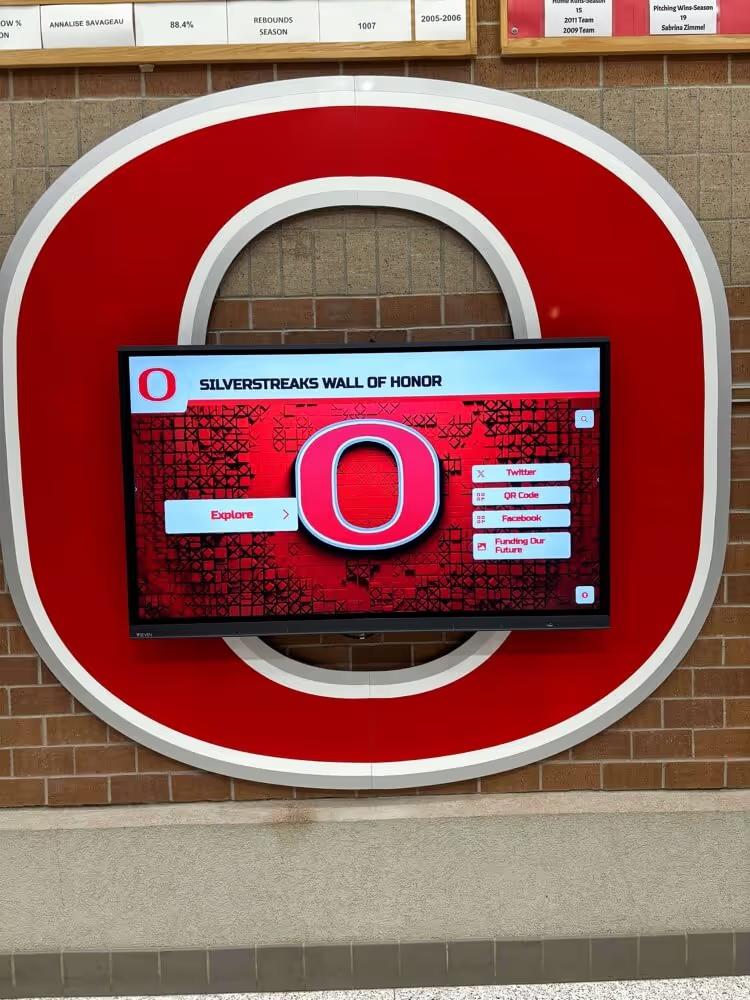
Recognition assets funded by booster programs — digital displays, hall of fame installations, named athletic facilities — represent sustained financial commitments that depend on sound debit card controls from the moment cardholders begin spending
What Is a Booster Club Debit Card Controls Policy?
A booster club debit card controls policy is a written document that defines:
- Who is authorized to carry a card — which officers or designated individuals may hold a debit card linked to the organization’s account, and what authorization process precedes card issuance
- What purchase limits apply — per-transaction maximums, daily spending caps, and any monthly aggregate limits on cardholder spending
- What categories of spending are permitted — which merchant categories the card may be used for and which are explicitly excluded
- What documentation each purchase requires — receipt format, submission timeline, and the expense report or purchase log that connects each transaction to an approved budget line
- How monthly review works — who conducts the review, what they compare, and what happens when a transaction cannot be documented
A policy that addresses all five elements gives the board, treasurer, school administration, and any future auditor a complete picture of how cardholder spending is authorized, documented, and verified. Organizations that issue debit cards without a written policy typically discover the gap only when a discrepancy cannot be explained or when a leadership transition leaves an incoming treasurer unable to account for prior spending.
Booster clubs that have built structured programs around year-round recognition — including organizations that rely on documented sponsor relationships to fund end-of-season sports awards and year-round recognition programs — understand that the financial records behind those commitments need to be airtight. Debit card documentation is part of that same record-keeping discipline.
Why Debit Card Controls Matter More Than Most Boards Realize
Debit cards are fundamentally different from the check-based disbursement controls most booster clubs already have in place. A check requires:
- A written or submitted invoice or reimbursement request
- Review and approval by an authorized officer
- A physical signature (often dual-signature above a threshold)
- A bank record that identifies the payee by name on the check itself
A debit card purchase requires none of those steps at the point of transaction. The cardholder swipes or taps, the funds leave the account instantly, and the bank record identifies only the merchant and the amount — not the business purpose, not the budget line, not the approval that preceded the purchase.
This structural difference means that the controls a booster club relies on for checks do not automatically carry over to debit cards. A new, specific policy is needed.
Three risk factors make debit card controls particularly important for volunteer-run booster organizations:
High officer turnover. Booster club boards turn over frequently — sometimes entirely within a single year. A cardholder who leaves mid-year without returning the card or submitting outstanding receipts creates a documentation gap the incoming treasurer may never be able to close.
Informal spending culture. Volunteer organizations frequently develop informal patterns — a trusted officer picking up supplies on the card, submitting a receipt later, getting verbal approval rather than documented authorization. When the trusted officer transitions out, the pattern persists with a new cardholder who may not have the same institutional knowledge of what is and is not appropriate spending.
Instant fund access. Because debit card transactions settle immediately, there is no window for a second review before funds leave the account. The only control points are the limits set in advance (purchase caps) and the review that happens afterward (monthly reconciliation). Both must be documented and enforced consistently.

Athletic recognition programs that depend on sustained booster funding need financial controls strong enough to sustain donor and sponsor confidence across every leadership transition
Setting Purchase Limits: Per-Transaction, Daily, and Category Caps
Purchase limits are the forward-looking control in a debit card controls policy — they define the boundaries of authorized spending before a transaction occurs. A cardholder who knows the per-transaction limit must plan larger purchases differently, which creates natural opportunities for advance board review.
Per-Transaction Limits
The per-transaction limit defines the maximum amount a cardholder may spend in a single purchase without additional authorization. Most booster clubs set this in the range of $100 to $500, calibrated to the typical size of event-related purchases — supplies, entry fees, equipment maintenance, and similar operational needs.
Purchases that would exceed the per-transaction limit should follow the organization’s standard approval process: a written or emailed request, board or treasurer approval documented in writing, and the approved amount noted in the purchase log before the purchase is made. The policy should specify whether a cardholder may split a single large purchase across multiple transactions to stay below the limit — and the answer should be no. Transaction splitting to avoid the per-transaction threshold is a recognized red flag in nonprofit financial controls and should be explicitly prohibited.
| Limit Type | Typical Range | Purpose |
|---|---|---|
| Per-transaction limit | $100 – $500 | Requires advance approval for larger purchases |
| Daily spending cap | $250 – $1,000 | Prevents high-volume unauthorized spending in a single day |
| Monthly aggregate limit | $500 – $2,500 | Bounds total cardholder discretionary spending per period |
| Single-vendor cap | Varies by policy | Flags recurring payments to the same merchant for review |
These ranges are illustrative — the appropriate limits depend on the organization’s annual budget, the typical size of operational purchases, and the number of cardholders. A club managing a $50,000 annual budget may set a $250 per-transaction limit; a club managing a $200,000 budget may set $500. What matters is that the limit is set in writing, approved by the board, and enforced consistently.
Daily Spending Caps
A daily spending cap limits the total amount a cardholder can spend in a single calendar day across all transactions. This control is particularly relevant for multi-day events — tournaments, away games, multi-program weekends — where a cardholder might legitimately make multiple smaller purchases in a single day but where uncapped daily access creates risk if the card is lost or compromised.
Most debit card issuers allow daily spending limits to be configured directly at the bank, meaning the limit is enforced at the point of transaction rather than relying solely on cardholder compliance. Setting the daily cap both in the written policy and at the bank account level provides redundant control.
Merchant Category Restrictions
Merchant category codes (MCCs) allow banks to restrict a debit card to approved spending categories and block specific categories entirely. A booster club might configure the card to permit purchases at sporting goods retailers, office supply stores, grocery stores (for concession supplies), and general merchandise retailers while blocking categories such as entertainment venues, travel agencies, and ATM withdrawals.
ATM cash withdrawals deserve specific attention. Most well-governed booster clubs prohibit using the debit card to withdraw cash entirely — the organization has a cash handling policy for event cash, and cash withdrawals from the debit card create an untraceable spending record that undermines the purpose of the debit card controls policy. If a cardholder needs petty cash for a specific purpose, the policy should define a separate petty cash process rather than allowing debit card ATM withdrawals.
Receipt Requirements: What Documentation Every Purchase Must Produce
Receipt requirements are the documentation control in a debit card controls policy — they define what evidence every cardholder must produce to connect each bank transaction to an authorized purpose. A bank statement line showing “$47.83 at Office Depot” is not documentation; a receipt showing exactly what was purchased, a signed expense report explaining the business purpose, and a notation of the budget line it applies to constitute documentation.
The 72-Hour Receipt Rule
Most booster club debit card policies require cardholders to submit receipts within 48 to 72 hours of any purchase. This timeline serves two purposes: it ensures receipts are submitted while the cardholder still remembers the business purpose, and it prevents a backlog of undocumented transactions that accumulates over weeks or months and is nearly impossible to reconstruct accurately.
The submission process should be simple enough that cardholders actually use it. Options include:
- A shared cloud folder where cardholders upload photos or scans of receipts immediately after purchase
- An expense reporting app that captures receipt images and prompts for business purpose at the time of submission
- A physical envelope in the treasurer’s possession where paper receipts are deposited, with a log sheet recording each submission
Whatever the process, the policy should specify the method explicitly — not leave it to cardholder preference.
What Each Receipt Submission Must Include
A complete receipt submission for every debit card purchase should include:
- The original receipt — itemized, not just the credit card summary slip; itemization shows what was actually purchased
- A written business purpose — a brief description of the event, program, or need the purchase served (“concession supplies for October 7 home game” rather than just “supplies”)
- The budget line — which approved budget category the expense applies to
- Cardholder signature — confirming the cardholder made the purchase and verifying the documentation is complete
If a receipt is lost, the cardholder should submit a written explanation noting the purchase amount, date, vendor, and business purpose, signed and dated. Lost-receipt explanations should be uncommon — a policy that treats lost receipts as routine creates a documentation gap. Repeated missing receipts from a single cardholder warrant a conversation with the board before the monthly review cycle.

Sponsors who invest in named recognition programs expect the same transparency in financial controls that they see in the recognition displays those investments fund — documented debit card policies are part of that trust relationship
Digital Receipt Submissions and Cloud Storage
Many cardholders now receive digital receipts by email or through retailer apps. A debit card controls policy should specify how digital receipts are handled — whether they are forwarded to a designated treasurer email address, uploaded to a shared organizational folder, or captured through an expense reporting tool.
The key requirement for digital receipts is the same as for paper: the submission must be organized so that any specific transaction can be matched to its receipt during the monthly review. A folder of unorganized receipt images with no connection to specific bank transactions does not constitute documentation — it is a collection of files that may or may not correspond to the transactions under review.
For programs that have developed structured approaches to organizing school records for long-term accessibility — similar to the systems that support back-to-school night planning and family communication records — the same organizational discipline applies to digital receipt management. Consistent folder structures, consistent file naming, and access controls that survive officer transitions are the standard.
Expense Report or Purchase Log
In addition to receipts, most debit card policies require cardholders to submit a periodic expense report — typically monthly — that lists all card transactions, matched to receipts, with the business purpose and budget line noted for each. This log becomes the primary reconciliation document: the treasurer compares the expense report to the bank statement and confirms that every line has a receipt and a business purpose.
The expense report requirement also creates a natural checkpoint for cardholders: at month’s end, a cardholder who has missing receipts or undocumented transactions must acknowledge the gaps in writing before submitting the report. That written acknowledgment is more useful than discovering the gap during the treasurer’s review.
The Monthly Review Process
Monthly review is the backward-looking control in a debit card controls policy — it examines what cardholders spent, compares those expenditures to the documentation submitted, and flags anything that cannot be explained. The review closes the loop that purchase limits open.
What Monthly Reviews Cover
A complete monthly debit card review compares:
- Bank statement to expense report — every line item on the bank statement for the card matches a line in the cardholder’s expense report, with no unaccounted transactions
- Expense report to receipts — every line in the expense report has a corresponding receipt or, where receipts are missing, a signed written explanation
- Receipts to budget — each documented expense falls within the approved budget category, does not exceed the per-transaction limit, and reflects a purpose consistent with the organization’s programs
- Purchase patterns — repeated purchases from the same vendor, unusual merchant categories, or purchases at times inconsistent with organizational activities (off-season, non-event days) warrant follow-up questions
The reviewer should also confirm that the cardholder submitted the expense report and receipts within the policy’s timeline — late submissions are a pattern worth noting, not just a administrative inconvenience.
Who Conducts the Review
The monthly review must be conducted by someone other than the cardholder. This is the same segregation-of-duties principle that applies to cash handling and bank reconciliation: the person who spent the money cannot also be the person who verifies the spending was appropriate.
In most booster club structures, the treasurer conducts debit card reviews, but the treasurer should not review their own card spending. The president, a vice president, or a designated audit committee member reviews treasurer card transactions. For small organizations, the monthly review can be conducted by whoever is not the cardholder — the key is that independence is maintained and documented with a review sign-off.
| Review Step | Who Performs It | Documentation Produced |
|---|---|---|
| Cardholder submits expense report and receipts | Cardholder | Signed expense report, receipts attached |
| Reviewer compares bank statement to expense report | Independent officer | Signed review checklist or memo |
| Discrepancies documented | Reviewer | Written note of outstanding items |
| Follow-up completed or escalated | Treasurer or board | Resolution documented in writing |
| Monthly reconciliation closed | Treasurer | Signed reconciliation record |
When the Review Reveals Problems
A monthly review that uncovers problems — missing receipts, transactions that exceed limits, purchases in prohibited categories, or transactions with no business purpose explanation — should follow a defined escalation path rather than being resolved informally.
Minor documentation gaps, such as a single missing receipt with a plausible explanation, can be resolved by requesting a written explanation from the cardholder and noting the resolution in the review record. Patterns of missing documentation, repeated limit violations, or transactions in prohibited categories warrant escalation to the full board before the next review cycle.
The policy should specify clearly what triggers escalation, who escalation goes to, and what authority the board has to suspend card access pending review. An officer whose card access is suspended during an investigation has a clear understanding of what is happening and why — an informal conversation without policy backing does not create that clarity.

Programs that commit to documenting athletic history across seasons recognize that the same disciplined record-keeping supports both recognition programs and the financial controls that fund them
Cardholder Authorization and Card Issuance
A debit card controls policy should define not just how cards are used but how they are issued and how access is managed when cardholders change.
Who May Hold a Card
Most booster clubs limit debit cards to the treasurer and one alternate — often the president or a designated purchasing officer. Issuing cards to multiple officers without limiting total cardholder count creates oversight complexity: each additional cardholder adds a monthly review cycle, an additional receipt stream, and additional risk that policies are followed inconsistently.
The policy should specify:
- Maximum number of cards issued at any time
- Which officer roles are eligible to hold cards
- The board approval process for issuing a new card or replacing a lost card
- The process for updating cardholder authorization when a new officer is elected
Card Issuance and Onboarding
Before a new cardholder receives a card, the policy should require that they:
- Read and sign a copy of the debit card controls policy
- Receive a briefing from the treasurer on receipt submission procedures, purchase limits, and prohibited spending categories
- Be assigned a starting-expense-report template so they know the documentation format the reviewer expects
A cardholder who signs the policy before receiving the card cannot later claim they were unaware of the limits or receipt requirements. The signed acknowledgment becomes the documentation that the organization provided training.
Card Return on Transition
Card return on officer transition is the most commonly missed step in booster club debit card management. When a cardholder leaves their position — whether at the end of an elected term, mid-year resignation, or removal from office — the card must be returned immediately, any outstanding receipts submitted within a defined window (typically five to ten business days), and the card cancelled or transferred to the successor.
The policy should specify that card access is revoked at the point of resignation or removal, not at the convenience of the outgoing officer. A card that remains active in an outgoing cardholder’s possession after their term ends is an uncontrolled access point to the organization’s funds.
Alumni engagement programs that depend on sustained booster relationships — like those explored in alumni engagement ideas for how universities keep graduates connected — benefit from the organizational credibility that comes from clean financial controls. When booster programs can demonstrate transparent governance, they build the institutional trust that brings alumni back as sponsors and donors year after year.
Connecting Debit Card Controls to Recognition Program Stewardship
A booster club debit card controls policy and the organization’s recognition programs are not separate systems. The debit card is frequently used to fund recognition-related purchases — equipment, supplies, printing, vendor payments, event costs — and the documentation those purchases require directly supports the recognition commitments the club has made to sponsors and donors.
When a business sponsor pays for a naming recognition or a display feature, that sponsorship funds specific deliverables. If the debit card is used to purchase materials or pay vendors associated with recognition delivery, those transactions need the same complete documentation as any other expense: receipt, business purpose, budget line, and independent review. The sponsor’s recognition obligation begins with a payment and ends with a documented delivery — the debit card documentation is part of that chain.
Programs that invest in permanent recognition infrastructure — digital displays, athletic record boards, named installations — are making long-term commitments that outlast any single officer’s tenure. The alumni gathering area design guide provides useful context for how schools think about creating lasting recognition spaces; the financial documentation behind those spaces is what makes the investment sustainable and verifiable across leadership transitions.
Recognition programs that span multiple seasons — including digital showcase boards for booster clubs and school athletic organizations — generate debit card expenses across those seasons: software subscriptions, content updates, maintenance vendor payments. A debit card controls policy that survives officer transitions ensures those recurring commitments are documented consistently, so the program continues without gaps when a new treasurer takes over.
For school programs that connect academic and athletic recognition — such as academic excellence awards and student recognition programs — the same documentation discipline that governs debit card spending supports the credibility of the recognition programs those expenditures fund.
Booster programs that establish named recognition elements — plaques, display panels, or inscribed award pieces — fund those commitments through the same accounts the debit card accesses. Resources covering memorial plaque wording and permanent recognition elements illustrate why the financial records behind permanent recognition matter: the commitment to a named element is indefinite, and the documentation of the original expenditure may be needed for years after the purchase was made.

Donor recognition programs that display alumni and sponsor names on permanent installations depend on the financial documentation that a debit card controls policy requires — from vendor payment receipts to the monthly review that confirms every purchase served its stated purpose
Booster Club Debit Card Controls: Summary Checklist
The checklist below covers the minimum elements a debit card controls policy should address. Use it to audit an existing policy or build a new one from scratch.
Card Issuance and Authorization
| Control | Policy Requirement |
|---|---|
| Cardholder eligibility | Defined by officer role; board approval required for each card issued |
| Maximum card count | Total number of active cards limited and specified in the policy |
| Signed acknowledgment | Cardholder signs policy before receiving card |
| Onboarding briefing | Treasurer briefs new cardholders on limits, categories, and receipt procedures |
| Card return protocol | Card returned and cancelled within defined period after officer transition |
Purchase Limits
| Control | Policy Requirement |
|---|---|
| Per-transaction limit | Dollar maximum for single purchase without advance authorization |
| Daily spending cap | Maximum total spending per calendar day |
| Monthly aggregate limit | Total monthly cardholder discretionary spending ceiling |
| ATM withdrawal prohibition | Debit card may not be used for cash withdrawals |
| Transaction splitting prohibition | Splitting a single purchase to avoid per-transaction limit is explicitly prohibited |
| Merchant category restrictions | Permitted and prohibited MCC categories specified; restrictions enforced at bank level |
Receipt and Documentation Requirements
| Control | Policy Requirement |
|---|---|
| Submission timeline | Receipts submitted within 48–72 hours of purchase |
| Itemized receipt required | Original receipt itemized by item, not only summary slip |
| Business purpose required | Written description of event, program, or need served by each purchase |
| Budget line notation | Each purchase assigned to an approved budget category |
| Cardholder signature | Signed expense report accompanies receipt submissions |
| Lost receipt procedure | Written signed explanation required; pattern of lost receipts escalated |
| Monthly expense report | Cardholder submits consolidated report matching all transactions to receipts |
Monthly Review
| Control | Policy Requirement |
|---|---|
| Independent reviewer | Monthly review conducted by officer who is not the cardholder |
| Bank statement comparison | Every bank transaction matched to expense report line |
| Receipt verification | Every expense report line matched to a receipt or written explanation |
| Budget compliance check | Each purchase verified against approved budget category and purpose |
| Pattern review | Unusual timing, vendors, or categories flagged for follow-up |
| Escalation trigger | Policy specifies what patterns trigger full board review |
| Review documentation | Reviewer signs completed review checklist before reconciliation closes |
Frequently Asked Questions
What should a booster club debit card controls policy include?
A booster club debit card controls policy should define who is eligible to hold a card, the board authorization process for card issuance, per-transaction and daily spending limits, permitted and prohibited merchant categories, receipt submission requirements (including timeline and format), the monthly independent review process, escalation procedures for policy violations, and the card return process for officer transitions. A written policy reviewed and approved by the board — and signed by each cardholder before the card is issued — is the foundation of effective debit card governance for volunteer-run organizations.
How much should a booster club's per-transaction debit card limit be?
Most booster clubs set per-transaction limits in the range of $100 to $500, calibrated to the typical size of operational purchases — event supplies, equipment maintenance, entry fees, and similar expenses. The right limit depends on the organization’s annual budget and the nature of its regular spending: a club managing $25,000 annually might set a $150 limit, while a club managing $150,000 might set $400 or $500. Purchases above the limit should require written advance authorization documented in the purchase log before the transaction is made. The policy should also explicitly prohibit splitting a single purchase across multiple transactions to avoid the per-transaction threshold.
Can a booster club treasurer review their own debit card spending?
No. The monthly review of any cardholder’s spending must be conducted by someone other than the cardholder themselves — this is the segregation-of-duties principle applied to debit card oversight. If the treasurer holds a card, the president, a vice president, or a designated audit committee member should review treasurer transactions. For small organizations with limited board structure, the key requirement is that the reviewer is independent of the transactions being reviewed. The review sign-off should be documented in writing so that the independence of the process is verifiable during an audit or board inquiry.
What happens to a booster club debit card when an officer leaves mid-year?
When a cardholder leaves their position — through resignation, removal, or end of term — the card should be returned and cancelled immediately, not at the outgoing officer’s convenience. The policy should specify a defined window (typically five to ten business days) for the cardholder to submit any outstanding receipts and a final expense report covering all transactions since the last monthly review. Card access should be revoked at the point of transition regardless of whether outstanding documentation has been submitted. If receipts are not submitted within the defined window, the review treats those transactions as undocumented and documents the gap accordingly.
Should booster club debit cards allow ATM cash withdrawals?
Most booster club governance advisors recommend prohibiting ATM cash withdrawals on organizational debit cards. Cash withdrawn from an ATM produces no itemized record of what was purchased, no vendor, and no business purpose — it is the least-documented form of spending available on a debit card. Organizations that need petty cash for specific purposes should maintain a separate petty cash fund governed by a documented petty cash policy, rather than allowing debit card ATM withdrawals. The prohibition should be stated explicitly in the debit card controls policy and, where the bank allows it, enforced through merchant category code restrictions at the account level.
Building a Recognition Program That Reflects Your Financial Standards
A booster club debit card controls policy is the set of rules that makes cardholder spending transparent, verifiable, and sustainable across every leadership transition. The purchase limits, receipt requirements, and monthly review process work together to ensure that every dollar spent through the debit card can be traced from authorization to delivery — and that the records necessary to verify that trace survive from one treasurer to the next.
The same financial discipline that governs debit card spending is what makes recognition commitments credible. When donors and sponsors see a booster organization that documents its purchases, reviews its cardholders independently, and maintains clean records through leadership changes, they see an organization whose recognition commitments they can trust. That trust is what turns a single-season sponsorship into a multi-year relationship — and a one-time donation into a permanent named element in the school’s athletic history.
See How Permanent Recognition Brings Financial Commitments to Life
Rocket Alumni Solutions builds interactive digital recognition displays for school athletic programs — giving booster clubs a visible, lasting platform for donor acknowledgment and sponsor recognition that reflects the commitments your organization has documented and honored. Schedule a demo to see what your facility could look like.
Schedule Your Recognition Display Demo